

OCIH Approach

Dr. Olsen’s clinical excellence, developed over thirty years of treating chronic and complex cases at OC Integrative Health in Lake Forest, California.

Over thirty years of treating chronic and complex cases, Dr. Greg Olsen, D.C. has developed a clinical methodology built on a single observation: most chronic conditions persist not because the body is broken, but because something is keeping it from doing what it was designed to do.

At OC Integrative Health in Lake Forest, California, this is how every case is approached — from the first evaluation through every adjustment to the care plan. It covers both how a case is evaluated and how care is built, beginning with an Integrative 6-System Evaluation and continuing through an individualized, sequenced treatment plan.

More about Dr. Olsen’s training and background →

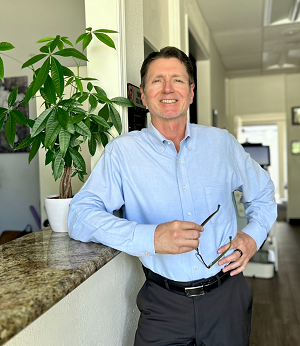
Dr. Greg Olsen - Integrative Health practitioner. Dr. Olsen at OC Integrative Health in Orange County, smiling at the front desk of his holistic wellness clinic, specializing in myofascial pain relief, chiropractic care, and integrative health treatments, applied kinesiology, brain based therapy, cognitive decline, nutrition, chronic pain, vertigo, dizziness, thyroid transformation, peripheral neuropathy, and concussion.

The Principles

Four principles the OCIH Approach is built on.

1. The body wants to be in balance. Chronic conditions persist not because the body has failed, but because something is interfering with its ability to regulate itself. The work of this approach is to identify the interference, not to override the body.

2. Symptoms are signals, not the disease. A symptom is the body reporting that a system is under stress. Treating only the symptom may quiet the signal without addressing what is sending it. The approach treats symptoms as information.

“The question is never just what hurts — it’s what is keeping this system out of balance, and why hasn’t it corrected itself.”

— Dr. Greg Olsen, D.C.

3. Systems interact; care should reflect that. Most chronic complaints do not live in a single system. Pain may be rooted in inflammation rather than structural damage. Fatigue may stem from hormonal signaling rather than poor sleep. The OCIH Approach evaluates systems together because dysfunction usually lives in the interaction.

4. No two patients are the same. Two people with the same diagnosis often require very different care, because their stressors, histories, and compensatory patterns differ. The approach is structured but not standardized — every plan is built for the individual case.

The Integrative 6-System Evaluation

The diagnostic phase of the OCIH Approach — six interacting systems considered together, examined where each case requires.

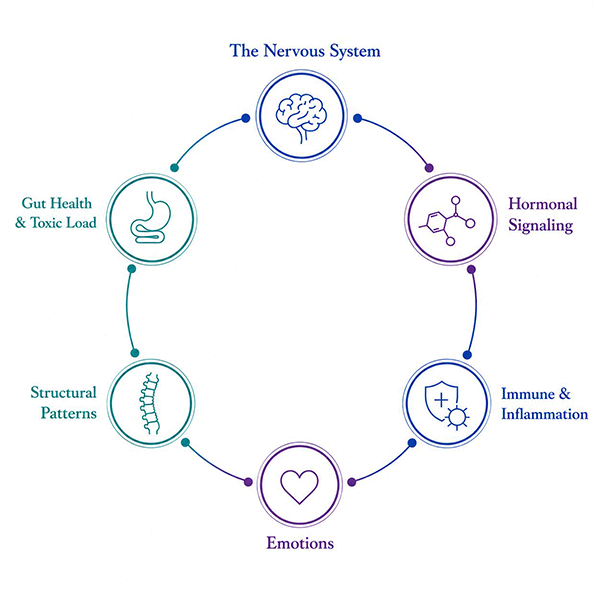
The OCIH Approach begins with what Dr. Olsen calls his Circle of Health — a structured evaluation that assesses six systems interacting together rather than organizing care by specialty. The evaluation focuses on the systems most relevant to the case; not every system requires investigation in every patient.

Diagram showing the functional medicine circle of health from Dr Greg Olsen

Dr. Olsen’s Circle of Health — the six interacting systems considered together.

Symptoms are typically the last thing to appear when the body is under stress, and the first to go when conditions improve even slightly.

Functional lab testing supports the evaluation where indicated, providing more complete information than standard reference ranges alone. Testing is selected based on the case, not run as a default panel.

What Makes Us Different

Why patients who have been through specialists, neurologists, and conventional care often find answers here that they could not find elsewhere.

Many of the patients who come to OC Integrative Health have already seen multiple doctors. They have had imaging that came back normal, labs that fell within standard reference ranges, and visits with specialists who each examined the system they were trained to look at. They have been told there is nothing more to try, or that their symptoms are something they will have to learn to live with. The OCIH Approach exists for these patients — because, in most of these cases, the problem was real, but no one had the right lens to find it.

Most chronic conditions don’t live in one system; they live in the interaction between systems — and standard care, organized by specialty, is not built to see that interaction. A cardiologist examines the heart, an endocrinologist examines hormones, a neurologist examines the nervous system, each one correctly doing their job in isolation. Dr. Olsen’s training is structured to find what that model misses. Over more than thirty years he has pursued advanced training in functional medicine, functional neurology, applied kinesiology, and chiropractic care — four disciplines that each look at the body through a different lens. Most practitioners are trained in one. A handful are trained in two. Holding all four under a single set of hands is genuinely uncommon — and it is what allows him to evaluate the interactions between systems that single-specialty care cannot.

The result is an evaluation that is both broader and more specific than what most patients have experienced. Broader, because it asks questions across systems that single-specialty care never gets to. More specific, because the focus narrows quickly to where each case actually requires investigation.

From Evaluation to Treatment

How the OCIH Approach moves from finding what’s driving a case to building care around it.

The OCIH Approach informs not just what gets evaluated, but how care is sequenced. What helps the body in week one is often different from what helps it in month three. As regulation improves, the care plan adapts — and what was once too much for the body to tolerate becomes appropriate.

Treatment draws from chiropractic, functional medicine, functional neurology, applied kinesiology, and a range of supporting therapies, applied intentionally based on what the case requires. The goal is durable change: a body that is better able to heal, adapt, and recover on its own.

Patients Love What We Do!

In their own words.

Ready for a different kind of evaluation?

(949) 859-5192

Frequently Asked Questions

Common questions about our approach.

Integrative means we assess and treat the body as a whole, interconnected system rather than evaluating one symptom or specialty at a time. Dr. Olsen combines functional medicine, functional neurology, chiropractic care, applied kinesiology, and other evidence-informed therapies based on what each patient’s clinical pattern requires — not based on a standard protocol.

Dr. Olsen’s training extends well beyond spinal manipulation. He holds advanced training in functional medicine, functional neurology, and applied kinesiology, and has been in practice since 1994. The OCIH Approach — the clinical methodology he has developed — addresses the nervous system, hormonal signaling, immune and inflammation, gut health and toxic load, structural patterns, and emotions together — making his approach significantly broader than conventional chiropractic care.

We specialize in complex, multi-system cases — chronic pain, peripheral neuropathy, vertigo and dizziness, post-concussion symptoms, cognitive decline, thyroid dysfunction, autoimmune conditions, and chronic fatigue. Most have already been through the standard system and been told their labs look normal, that it’s probably stress, or that they simply have to manage it.

Post-concussion evaluation at OC Integrative Health looks at multiple interacting systems: vestibular and eye-movement function, autonomic regulation, cervical mechanics, cognitive processing, and inflammatory load. Rather than treating the concussion as a single isolated event, Dr. Olsen maps which systems remain dysregulated and uses functional neurology tools — including neurofeedback, BrainTap, Cranial Facial Release, and targeted brain-based therapy — to restore coordinated function.

Rather than relying solely on standard reference ranges, Dr. Olsen uses functional lab panels evaluating hormonal balance, inflammatory markers, gut function, nutrient status, toxic burden, and immune patterns. Testing is ordered based on clinical presentation — not as a fixed panel — so patients only run the labs that will actually inform their care plan.

The OCIH Approach is the clinical methodology Dr. Greg Olsen, D.C. has developed over more than thirty years of practice. It covers both how a case is evaluated and how care is built. The diagnostic phase — called the Integrative 6-System Evaluation — assesses six interacting systems together: the nervous system, hormonal signaling, immune and inflammation, gut health and toxic load, structural patterns, and emotions. Treatment is then built around what the evaluation reveals, sequenced to what each patient’s body is ready to absorb.

Because symptoms are typically the last thing to appear when the body is under stress, and the first to go when conditions improve even slightly. Treating only what’s visible often produces temporary relief without addressing what’s sustaining the problem. Dr. Olsen works to reduce symptoms while building a clear understanding of what is driving them — so improvement is durable, not just temporary.

Standard functional medicine evaluations typically apply a similar workup to most patients, often centered on a fixed set of lab panels. The OCIH Approach is structured around six interacting systems but tailored to where each case actually requires investigation. It also integrates clinical disciplines that most functional medicine practices don’t — applied kinesiology, functional neurology, and structural assessment — alongside lab-based functional medicine. Treatment is built around the same individualized lens used in the evaluation, sequenced to what the body can absorb at each stage.

Sequencing depends on what the body can tolerate at each stage. In a dysregulated nervous system, aggressive structural work or detox protocols can backfire — so we often begin by calming autonomic function before introducing more demanding interventions. In other cases, structural interventions create the space for nutritional and hormonal changes to take hold. Dr. Olsen evaluates which system is most overwhelmed and which intervention will create the most stable foundation, then layers additional care as the body shows it’s ready.

This is common. Many patients arrive having already done elimination diets, supplement protocols, hormone testing, or other functional approaches without lasting results. The most frequent reasons prior functional care doesn’t hold are missed nervous system involvement, structural patterns that weren’t addressed, or sequencing that was right in principle but wrong for the patient’s stage. Dr. Olsen reviews what was tried, what changed, and what didn’t — and uses that history to focus the evaluation rather than starting from scratch.

The OCIH Approach emerged from more than thirty years of clinical practice. Dr. Olsen graduated from the Los Angeles College of Chiropractic in 1994 and pursued postgraduate training in functional neurology, applied kinesiology, and neuro-endocrine assessment. Over decades of treating patients whose chronic conditions had not resolved through conventional care, he developed a structured way of evaluating the interactions between systems that standard medical specialties typically examine in isolation — and a corresponding way of building treatment around what the evaluation revealed. The OCIH Approach is the formalization of that clinical thinking.

Call Us